


Send Message
Privacy statement: Your privacy is very important to Us. Our company promises not to disclose your personal information to any external company with out your explicit permission.
This guide answers two questions every specifier faces: how to match a belt press to your sludge and scale, and what to demand from a supplier before you sign.
Start from feed solids and hourly volume, not from a catalogue model — those two numbers alone eliminate 70% of the configs on the market. The single most common mistake in how to choose belt filter press for my sludge type is picking belt width from budget rather than from throughput, then discovering the line can't keep up during storm flow.
Match the three variables in order:
Use this belt-width reference as a first cut (mixed sludge, 1–4% feed, typical polymer 3–6 kg/t DS):
| Belt width | Typical capacity (m³/h) | Best fit |
| 1.0 m | 4–8 | Small packaged plants, leased sites |
| 1.5 m | 8–15 | Municipal substations |
| 2.0 m | 15–25 | Medium municipal / food plants |
| 2.5 m | 25–38 | Large municipal |
| 3.0 m (ultra-wide) | 38–55 | Mega plants, single-line duty |
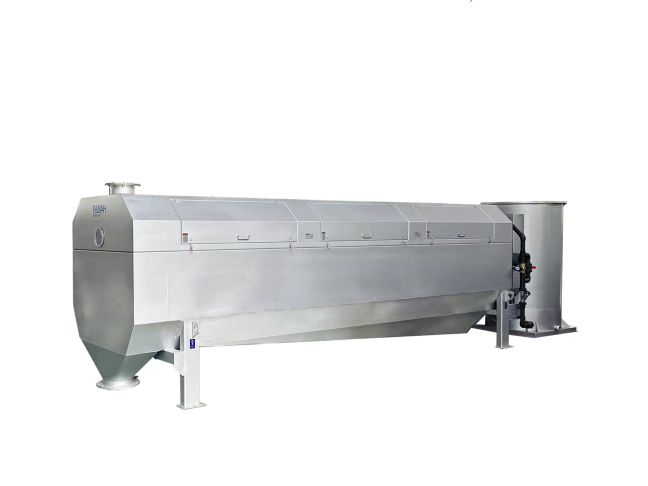
For thin, high-volume WAS, the triple-belt design changes the math: instead of buying a separate thickener plus a press, one HTB3-style unit thickens and dewaters in series, removing a building, a pump set and a polymer point. Haibar ships these as factory-tested skids, and the integrated layout is usually cheaper to install than two standalone machines even before you count the saved concrete.
✅ Selection rule: if your feed is below 2% DS and your site is space-limited, specify a triple-belt integrated unit; if your feed is already 3%+ DS and volume is the only constraint, a single ultra-wide belt is the leaner buy. This is the heart of how to choose belt filter press for my sludge type — match the machine to the sludge, never to the budget line.
✅ Bottom line: Belt width is set by peak volume and feed solids, not price — and below 2% DS a triple-belt integrated unit beats a separate thickener-plus-press on both footprint and install cost.
A credible belt filter press manufacturer for municipal wastewater treatment plant must prove four things beyond a low quote: consistent cake dryness under variable feed, low wash-water and polymer consumption, fast spare-parts turnaround, and the engineering depth to customize the build to your layout. Municipal duty is unforgiving — feed solids swing with season and storm, and a press that only performs in the datasheet will cost you in hauled-away water weight.
Demand these specifics in writing:
When you evaluate suppliers, weigh total installed cost, not unit price. An ultra wide belt filter press 3000mm for large capacity sludge costs more upfront than a 2 m line but removes a second frame, a second building bay and a second operator position — often a 15–25% saving on civil works for large plants.
✅ Bottom line: Choose a manufacturer who guarantees cake dryness on your actual sludge and offers OEM/ODM customization, because municipal feed variability will expose any generic off-the-shelf build.
Q: Is an ultra-wide 3000mm belt filter press worth it for a small plant? A: Only if peak throughput exceeds roughly 30 m³/h. Below that, a 1.5–2 m line is cheaper to buy and maintain. An ultra wide belt filter press 3000mm for large capacity sludge pays off when it lets you avoid running two parallel standard lines and their doubled civil, wash-water and labor cost.
Q: How do I decide between a standard belt press and a triple-belt unit when I choose belt filter press for my sludge type? A: If your feed is already 3%+ DS, a standard belt press is enough. If it is thin WAS below 2% DS, a triple-belt (thickener + two dewatering belts) does the job in one machine and one building. The triple-belt route also simplifies polymer dosing to a single point, which is the practical answer to how to choose belt filter press for my sludge type on space-limited sites.
Q: Do Chinese belt filter press manufacturers offer OEM and custom builds for municipal projects? A: Yes. A qualified belt filter press manufacturer for municipal wastewater treatment plant such as Haibar provides OEM/ODM, private-label and fully non-standard builds from its China factory, with belt width, drive, polymer system and PLC control tailored to the project, plus reference installations in 30+ countries.
As a dedicated belt filter press manufacturer for municipal wastewater treatment plant projects, Haibar sizes from your feed solids, peak volume and cake target, then returns a configured proposal — ultra-wide 3000mm single-line or HTB3 triple-belt integrated — with OEM/ODM options and reference plants near you. Contact Shanghai Haibar Mechanical Engineering Co., Ltd. for a free application assessment and a configured quote.Mobile: +86 13816290005
Tel: +86-21-50192688
Author:
Mr. Shanghai Haibar Mechanical Engineering Co., Ltd.
E-mail:
Phone/WhatsApp:
Email to this supplier
Author:
Mr. Shanghai Haibar Mechanical Engineering Co., Ltd.
E-mail:
Phone/WhatsApp:
Privacy statement: Your privacy is very important to Us. Our company promises not to disclose your personal information to any external company with out your explicit permission.
Fill in more information so that we can get in touch with you faster
Privacy statement: Your privacy is very important to Us. Our company promises not to disclose your personal information to any external company with out your explicit permission.