
Municipal Sewage Treatment

Industry Background
Municipal sewage treatment plants commonly face challenges such as large treatment capacity, stable sludge production, and complex composition. The sludge typically exhibits high organic content, strong hydrophilicity, and significant compressibility, which can easily lead to filter cloth clogging and incomplete cake release during dewatering, directly affecting operational efficiency and disposal costs.
Technical Approach
To address the physical characteristics of municipal sludge, Haibar's dewatering equipment employs a multi-stage gravity drainage and progressively pressurized mechanical design, creating a dewatering path aligned with material properties. The system utilizes an automatic filter cloth cleaning technology to consistently maintain medium permeability, while its modular structure allows adaptation to the process layout and operational needs of various treatment plant scales.
To address the physical characteristics of municipal sludge, Haibar's dewatering equipment employs a multi-stage gravity drainage and progressively pressurized mechanical design, creating a dewatering path aligned with material properties. The system utilizes an automatic filter cloth cleaning technology to consistently maintain medium permeability, while its modular structure allows adaptation to the process layout and operational needs of various treatment plant scales.
On-site Photos
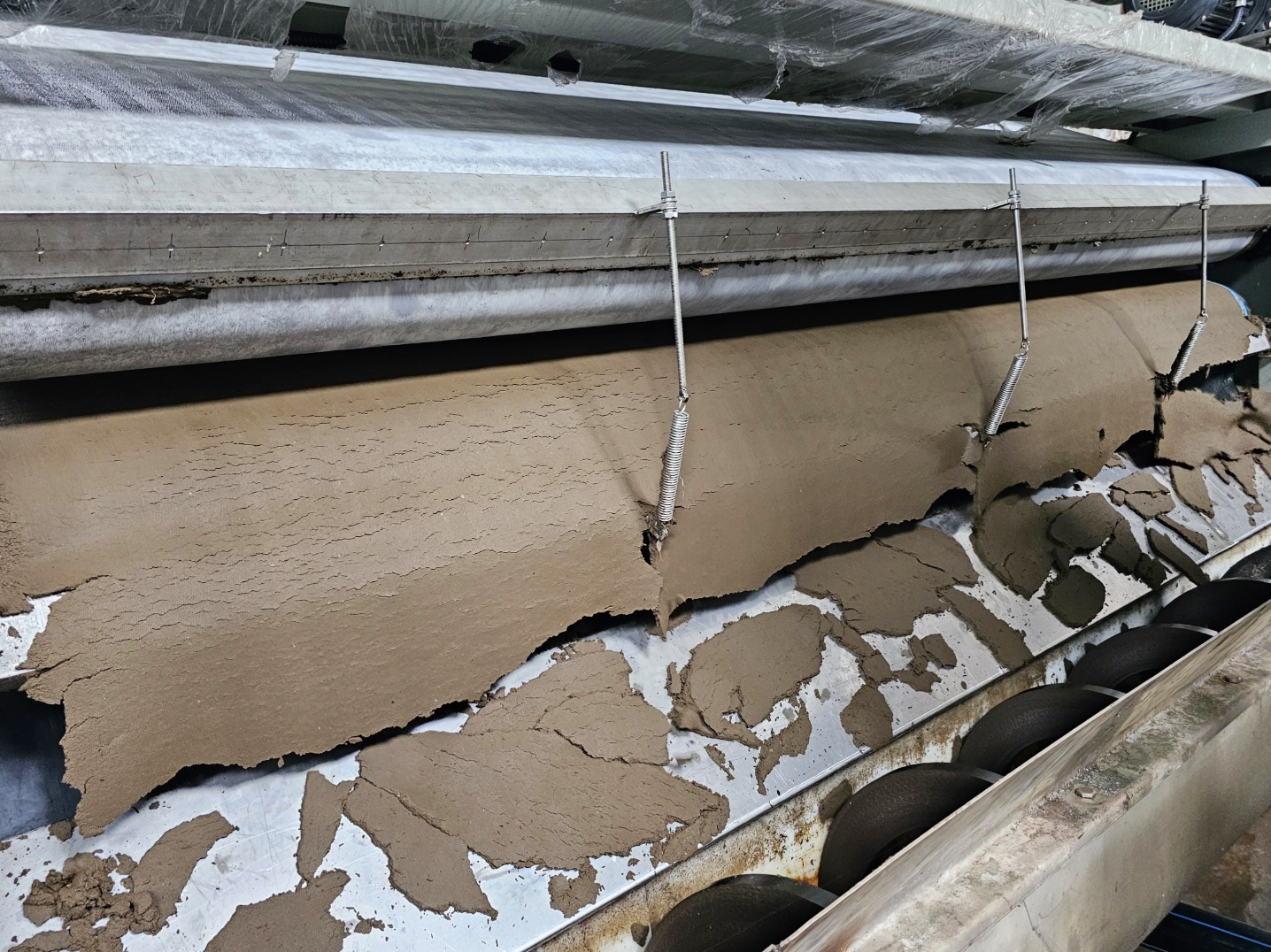
Taken at a municipal sewage treatment plant in Liaoning, the Haibar integrated thickening and dewatering system (3-meter belt width) has been operating stably since its 2025 commissioning. The unit is shown continuously processing high-organic sludge, producing uniform and compact filter cakes. The new generation automated control system has effectively ensured a notable improvement in the plant's overall sludge treatment efficiency.

Share to:


