


Send Message
Privacy statement: Your privacy is very important to Us. Our company promises not to disclose your personal information to any external company with out your explicit permission.
This article gives you a decision framework, then drills into the two factors buyers most often underestimate: wash-water and energy, and behavior on oily sludge.
Pick by throughput and sludge type, using five ranked decision factors — cake dryness, polymer, wash-water, footprint and O&M skill — because the "winner" flips at roughly 10–15 m³/h. The belt filter press vs screw press which is better 2026 question is best answered with a side-by-side, then a rule.
| Factor | Belt filter press | Multi-disc screw press |
| Cake dryness | 18–28% DS (25–28% high-pressure) | 15–22% DS (up to 25% tuned) |
| Polymer use | 3–6 kg/t DS (lower at scale) | 4–8 kg/t DS |
| Wash water | High, continuous belt wash | Low, intermittent self-clean |
| Energy | 2–7.5 kW | 0.5–3 kW |
| Footprint | Large (long frame) | Compact |
| O&M skill | Moderate (belts, rollers) | Low (few wear parts) |
| Best for | >10 m³/h, fibrous, variable | <10 m³/h, tight space, oily |
The decision rule:
Haibar sizes both and will run a pilot on your actual sludge before recommending, which removes most of the guesswork.
✅ Bottom line: Choose a belt press above ~15 m³/h when dryness drives cost, and a screw press below ~5 m³/h or where space and wash-water are tight — the crossover is roughly 10 m³/h.
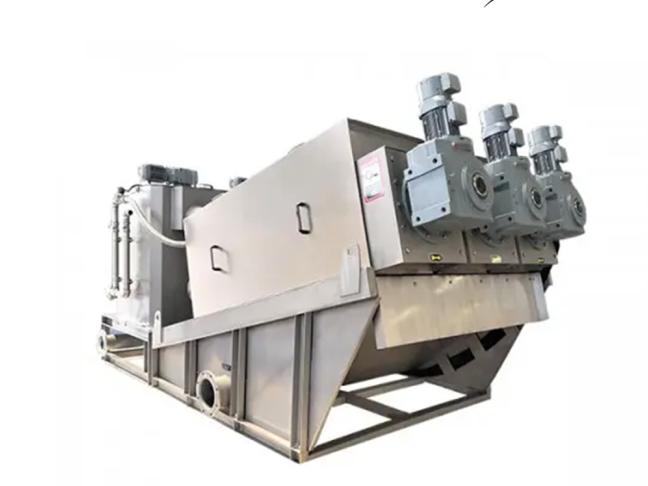
The screw press beats the belt on both energy and wash-water, but loses on polymer and peak dryness — and on oily sludge the screw's self-cleaning rings give it a clear edge that often overrides the dryness gap. This is where the screw press versus belt press energy wash water consumption numbers and the multi disc screw press vs belt filter press for oily sludge behavior actually decide the buy.
Energy and wash-water reality:
Oily and high-FOG sludge:
Haibar supplies both from its China factory with OEM/ODM customization, so the choice stays technical rather than constrained by a single catalogue.
✅ Bottom line: The screw press wins on energy and wash-water and is the safer bet on oily sludge, while the belt press holds the edge on dryness and polymer at high volume — decide on your dominant constraint, not on a single metric.
Q: Belt filter press vs screw press which is better 2026 for a 20 m³/h food plant with high fat? A: At 20 m³/h the belt press wins on dryness and haul cost, but high fat pushes toward the screw for blinding resistance. The practical answer is a belt press with correct polymer and pre-treatment, or a screw if wash-water and operator skill are the bigger constraint. Pilot both on your sludge.
Q: Why does the multi disc screw press vs belt filter press for oily sludge usually favor the screw? A: Fats blind a belt's cloth and force constant washdowns, while the screw's moving rings self-clean and keep running on high-FOG feed. With proper polymer the screw stays online where a belt would stall.
Q: In the screw press versus belt press energy wash water consumption comparison, which costs more to run? A: The screw press costs less to run on energy and wash-water (about one-tenth the belt's water draw), but it usually uses more polymer per ton. Net operating cost depends on your local water, power and chemical prices — model all three, not just one.
Send Haibar your throughput, sludge type and disposal target, and our China factory will return a belt-vs-screw comparison sized to your numbers, with OEM/ODM options for either technology. For oily sludge the screw-versus-belt trade-off is worth modeling before you commit. Contact Shanghai Haibar Mechanical Engineering Co., Ltd. for a free pilot assessment and configured quote.
Author:
Mr. Shanghai Haibar Mechanical Engineering Co., Ltd.
E-mail:
Phone/WhatsApp:
Email to this supplier
Author:
Mr. Shanghai Haibar Mechanical Engineering Co., Ltd.
E-mail:
Phone/WhatsApp:
Privacy statement: Your privacy is very important to Us. Our company promises not to disclose your personal information to any external company with out your explicit permission.
Fill in more information so that we can get in touch with you faster
Privacy statement: Your privacy is very important to Us. Our company promises not to disclose your personal information to any external company with out your explicit permission.