


Send Message
Privacy statement: Your privacy is very important to Us. Our company promises not to disclose your personal information to any external company with out your explicit permission.

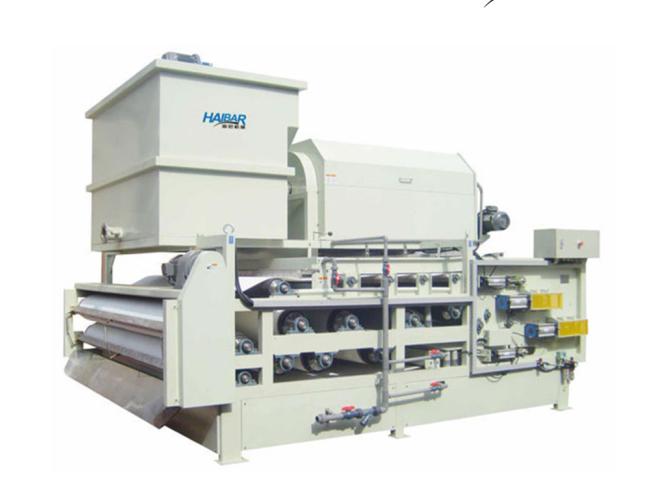
A triple-belt system is one integrated machine that thickens and dewaters sludge in three consecutive belt zones, replacing a standalone thickener followed by a separate belt press. The first belt runs a gravity drainage deck that lifts feed from roughly 1–2% to 4–6% dry solids. The second belt applies wedge and low-pressure squeezing to pre-dewater the slurry. The third belt then drives the cake through a tightening roller stack for high-pressure shear, reaching 18–25% dry solids in a single pass.
A conventional line splits those jobs: a rotary-drum or Belt Thickener feeds a buffer hopper, then a pump moves the thickened sludge across the plant to a separate belt press. Each hand-off needs its own drive, frame, walkway, controls and operator attention. Haibar's HTB3 triple-belt series folds all three zones onto one skid with one motor train, so a single triple belt sludge thickening and dewatering system manufacturer is responsible for the whole duty from feed to cake discharge.
The design family is broader than one model. A drum belt sludge thickening and dewatering integrated machine uses a rotating drum for the first thickening stage instead of a flat gravity deck, which suits fibrous or fast-draining sludges that blind a flat belt. Both approaches share the same goal — fewer machines, one responsibility — but pick the front end based on sludge drainability rather than price alone.
✅ Bottom line: A triple-belt unit collapses thickener-plus-press into one skid with one drive train, so you trade two machines and a transfer step for a single integrated responsibility.
Integrating the two stages saves 40–50% of floor space and one full material-transfer step, but it locks you into a single machine's duty range and creates one point of failure. The table below stacks the integrated approach against a separate thickener and press on the numbers that actually hit your budget.
| Factor | Triple-belt integrated | Separate thickener + press |
| Footprint | 1 unit, ~40–50% less floor area | 2 machines + pump + buffer hopper |
| Capital cost | Lower (one frame, one drive) | Higher (two frames, two drives) |
| Sludge transfers | None (in-line) | 1–2 (odour, leak risk) |
| Labor / control | One operator, one HMI | Two zones to tune separately |
| Redundancy | Single point of failure | Either stage can back up the other |
| Duty flexibility | Fixed within one machine range | Easy to upsize one stage only |
The disposal argument is where the drum belt sludge thickening and dewatering integrated machine and triple-belt share the same payoff. A high dryness belt filter press for lower disposal cost is not a slogan — every point of cake solids above the landfill or incineration threshold removes payable water weight. Moving from 18% to 24% dry solids on 5,000 t/yr of cake cuts roughly 300 t of trucked water, and at a typical haul-and-tip fee of €25–45/t that is a recurring €7,500–13,500/yr saving before counting smaller polymer and energy use.
The trade-off is rigidity. If your flow swings far above the unit's rated throughput, a separate line lets you add a second press while keeping the thickener; an integrated unit forces a whole-machine upgrade. For steady municipal, food or industrial flows inside one duty band, Haibar offers the unit as a custom build and integration wins on cost and simplicity. For highly variable or fast-growing sites, two separate stages keep your options open.
✅ Bottom line: Integrate when your flow is steady and sits inside one duty band; keep stages separate when throughput swings widely or you expect to upsize one stage only.
Q: Can a triple-belt system handle variable feed solids, or does integration reduce flexibility? A: A triple belt sludge thickening and dewatering system manufacturer sizes the unit to a feed range, typically 0.5–4% inlet solids, and the three zones self-balance within that band. Outside the band you lose efficiency, so treat integration as a steady-flow solution rather than a swing-duty one. Haibar offers pilot testing on your actual sludge before final sizing.
Q: How does a drum-belt integrated machine differ from a triple-belt unit for my plant? A: A drum belt sludge thickening and dewatering integrated machine thickens on a rotating drum, which resists blinding on fibrous or fast-draining sludge, while a triple-belt uses a flat gravity deck better suited to fine, slow-draining biological sludges. Both are available as OEM/ODM builds, and the choice is driven by drainability and foulant load, not by price.
Q: Does integrating thickening actually raise cake dryness enough to cut disposal cost? A: Yes — integration does not lower dryness versus a separate line; it reaches the same 18–25% range while saving space and transfers. A high dryness belt filter press for lower disposal cost still depends on correct polymer and belt tension, so the saving comes from removed handling steps plus every dry-solids point above the disposal threshold. Work with a single supplier who tunes polymer and belt tension to your sludge to lock in that saving.
Send Haibar your feed solids, peak flow and cake target, and our China factory will return a sized proposal — HTB3 triple-belt or drum-belt integrated — with reference plants near you. Shanghai Haibar Mechanical Engineering Co., Ltd. operates an 11,000 m² plant and exports to 30+ countries; contact us for a free pilot assessment and a configured quote.
Author:
Mr. Shanghai Haibar Mechanical Engineering Co., Ltd.
E-mail:
Phone/WhatsApp:
Email to this supplier
Author:
Mr. Shanghai Haibar Mechanical Engineering Co., Ltd.
E-mail:
Phone/WhatsApp:
Privacy statement: Your privacy is very important to Us. Our company promises not to disclose your personal information to any external company with out your explicit permission.
Fill in more information so that we can get in touch with you faster
Privacy statement: Your privacy is very important to Us. Our company promises not to disclose your personal information to any external company with out your explicit permission.