


Send Message
Privacy statement: Your privacy is very important to Us. Our company promises not to disclose your personal information to any external company with out your explicit permission.
Chemical sludge fails belt presses and centrifuges for three reasons — hazard, viscosity and corrosion — and ignoring any one of them turns a dewatering project into an EHS and maintenance nightmare. Unlike municipal biosolids, a single chemical stream can carry heavy metals, residual organics, acids or salts that change everything downstream.
For plant managers responsible for sludge dewatering for chemical industry hazardous sludge, the three failure modes above mean you must specify for the worst variable, not the average. For the driest possible cake from a difficult, toxic feed, a Plate And Frame Filter Press for chemical sludge high dryness is often the right call: it reaches 30–45% dry solids under high pressure, far above a belt press's 18–25%, which directly cuts the tonnage you pay to dispose of as hazardous waste.
✅ Bottom line: Treat chemical sludge as a three-variable problem — toxicity, viscosity and corrosion — and specify materials and dryness for the worst of the three, not the average.
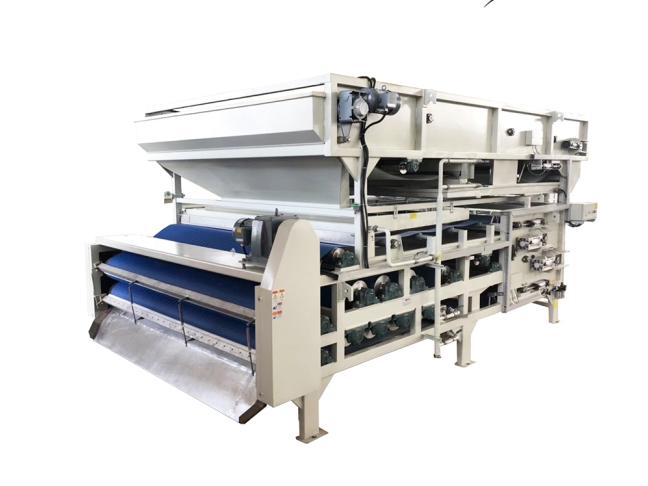
A belt filter press can handle many chemical sludges if its polymer dosing and pre-conditioning are set correctly, but you should switch to a plate-and-frame press when the sludge is both hazardous and very sticky or when the disposal route rewards very high dryness. The decision hinges on the two systems' different operating logic.
The belt filter press polymer dosing system requirements for chemical sludge are stricter than for municipal feed. Meeting them means planning for:
Haibar supplies integrated dosing skids matched to its belt presses and offers custom polymer packages for high-viscosity chemical sludges. For EPC contractors, these are available with full export documentation. When the sludge is very hazardous or high-solids, Haibar's manufacturer-grade plate-and-frame presses close the gap where belt units cannot reach target dryness.
Before reading it, note that the belt filter press polymer dosing system requirements shown are the minimum for sticky chemical feed, not municipal defaults. The table below contrasts a belt press with a plate and frame filter press for chemical sludge high dryness on the factors that matter for chemical streams:
| Factor | Belt filter press | Plate-and-frame press |
| Cake dryness | 18–25% DS | 30–45% DS |
| Polymer dose | 3–8 kg/t DS | 2–5 kg/t DS (often lime-assisted) |
| Cycle mode | Continuous | Batch (1–3 h/cycle) |
| Best for | Moderate-hazard, free-draining | Hazardous, sticky, high-dryness mandate |
| Footprint per t/h | Lower | Higher |
Choose a belt press when the sludge is free-draining and the disposal cost gap does not justify batch operation; choose plate-and-frame when every dryness point saves hazardous-waste tonnage or when the sludge blinds belts.
✅ Bottom line: Use a belt press with tuned polymer dosing for free-draining chemical sludge, and move to a plate-and-frame press when hazardous classification or stickiness makes high dryness mandatory.
Q: Can a belt filter press handle hazardous chemical sludge safely? A: Yes, with SS316 or PP contact parts, sealed belt enclosures and a conditioned polymer feed. For the driest, most toxic cakes, Haibar recommends a plate and frame filter press for chemical sludge high dryness to minimize hazardous tonnage when planning sludge dewatering for chemical industry hazardous sludge.
Q: Why does my chemical sludge need more polymer than municipal sludge? A: Chemical sludges are more colloidal and sticky, so floc formation needs 3–8 kg/t DS versus 2–4 kg/t DS. Meeting the belt filter press polymer dosing system requirements — correct make-up, aging and pre-conditioning — prevents wet cake and belt blinding.
Q: Does Haibar supply chemical-duty dewatering as a custom package? A: Yes. Shanghai Haibar Mechanical Engineering Co., Ltd. is a manufacturer offering belt and plate-and-frame units with corrosion-resistant materials, integrated dosing and export documentation for chemical plants worldwide.
Send Haibar your sludge analysis (heavy metals, pH, solids, viscosity) and target dryness, and our engineering team will return a sized proposal — belt press with matched dosing, or plate-and-frame for maximum dryness — with OEM/ODM options for EPC and chemical-plant buyers. Shanghai Haibar Mechanical Engineering Co., Ltd. operates an 11,000 m² plant and exports to 30+ countries; contact us for a free pilot assessment and a configured quote.
Author:
Mr. Shanghai Haibar Mechanical Engineering Co., Ltd.
E-mail:
Phone/WhatsApp:
Email to this supplier
Author:
Mr. Shanghai Haibar Mechanical Engineering Co., Ltd.
E-mail:
Phone/WhatsApp:
Privacy statement: Your privacy is very important to Us. Our company promises not to disclose your personal information to any external company with out your explicit permission.
Fill in more information so that we can get in touch with you faster
Privacy statement: Your privacy is very important to Us. Our company promises not to disclose your personal information to any external company with out your explicit permission.