


Send Message
Privacy statement: Your privacy is very important to Us. Our company promises not to disclose your personal information to any external company with out your explicit permission.
A typical municipal plant feeds 0.5–2% dry solids and should target 18–22% cake for landfill, 22–28% for incineration and 20–25% where land application is still permitted — because the disposal route, not the machine, sets the dryness number. Plan throughput from population, not from a guessed sludge volume.
| Disposal route | Required cake dryness (% DS) | Why it matters |
| Landfill (wet line) | 18–22% | Most landfills reject <18% as leachate risk |
| Incineration | 22–28% | Higher DS cuts auxiliary fuel burn |
| Cement / co-processing | 25–30% | Dryer feed means lower kiln energy |
| Land application* | 20–25% | *Restricted in many regions; check local rules |
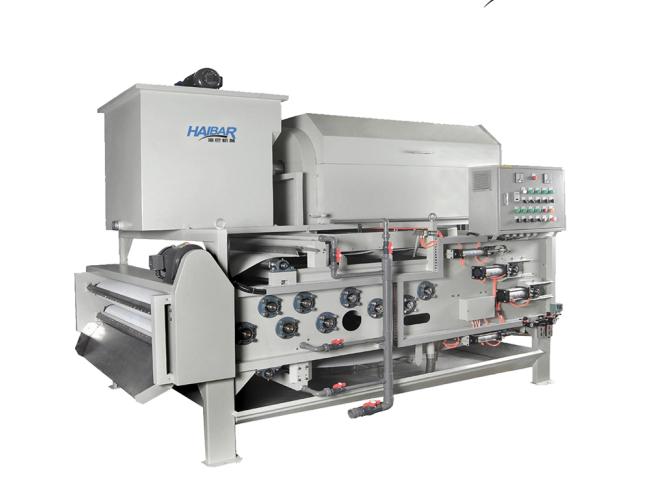
For sludge dewatering for municipal wastewater treatment plant projects, start from that per-capita load: a sewered population of 100,000 generates roughly 5–10 t of dry solids per day, which at 1% feed is 500–1000 m³/day of sludge to dewater. That needs a belt press sized near 1.5–2.5 m width running ~20 h/day, and Haibar's factory-built municipal presses are configured to those exact numbers. The sludge cake dryness percent required for landfill incineration is the binding constraint — if your only outlet is a landfill with an 18% floor, specify the press to hit 20% consistently rather than the catalogue 25% that merely wastes polymer.
Key planning checks:
✅ Bottom line: Set cake target from the disposal route (18–22% landfill, 22–28% incineration) and size the press on dry-solids load with 20–30% headroom, not on guessed volume.
A municipal belt-press line typically spends €30–80 per ton of dry solids in polymer, energy, labor, maintenance and depreciation — but the Sludge Dewatering Equipment cost per ton dry solids is small next to cake haulage, which can run €20–60 per ton of wet cake. As a China manufacturer, Haibar sizes these trade-offs with EPC teams so the specified width matches both the disposal floor and storm-peaking headroom. Polymer is the largest variable you control, so it deserves the most attention.
| Cost element | Typical €/t dry solids | Notes |
| Polymer (cationic) | 8–20 | 2–6 kg/t DS at €2–4/kg |
| Energy | 4–10 | 2–7.5 kW belt press, ~20 h/day |
| Labor & maintenance | 10–30 | One operator, belts and rollers |
| Depreciation | 5–20 | Spreads capital over service life |
| Total operating | ~30–80 | Excludes cake disposal |
The sludge Dewatering Equipment cost per ton dry solids shown above covers only on-site operation; cake haulage and tipping fees usually dominate lifetime cost. Polymer dose sits at 2–6 kg/t DS — primary sludge on the low end (2–4), waste activated sludge on the high end (4–6). Because sludge dewatering for municipal wastewater treatment plant duty mixes both, most plants land at 3–5 kg/t DS. Every point of extra dryness above the sludge cake dryness percent required for landfill incineration removes paid water weight, so a press that reliably hits 22% instead of 18% can cut haulage tonnage ~5–8%.
When to consider a different configuration:
✅ Bottom line: Budget €30–80 per ton of dry solids for operating cost and attack polymer first; the real saving is haulage avoided by hitting the disposal-floor dryness reliably.
Q: What belt width do I need for a 100,000-population municipal plant? A: Plan on 5–10 t DS/day; at 1% feed that is 500–1000 m³/day, which a 1.5–2.5 m belt press covers at 20 operating hours. The sludge cake dryness percent required for landfill incineration (18–22%) should set your target, with 20–30% headroom on width for storm flows.
Q: Why does my cost per ton look higher than the catalogue figure? A: Catalogues quote the sludge dewatering equipment cost per ton dry solids in ideal conditions; real plants pay more for polymer on poor-condition sludge, labor and haulage. Measure your own kg/t DS and €/t DS for a month before comparing quotes.
Q: Can Haibar supply a municipal press as a turnkey package? A: Yes. Haibar delivers belt presses and integrated thickening-dewatering units as OEM-configured packages, with reference municipal plants across 30+ countries and full documentation for EPC tenders.
Send Haibar your sewered population, feed solids and disposal route, and our team will return a sized proposal — belt width, cake target and polymer budget — tailored to your duty. Shanghai Haibar Mechanical Engineering Co., Ltd. operates an 11,000 m² plant and exports to 30+ countries; contact our supplier team for a free application assessment and a configured quote.Mobile: +86 13816290005 Tel: +86-21-50192688
Author:
Mr. Shanghai Haibar Mechanical Engineering Co., Ltd.
E-mail:
Phone/WhatsApp:
Email to this supplier
Author:
Mr. Shanghai Haibar Mechanical Engineering Co., Ltd.
E-mail:
Phone/WhatsApp:
Privacy statement: Your privacy is very important to Us. Our company promises not to disclose your personal information to any external company with out your explicit permission.
Fill in more information so that we can get in touch with you faster
Privacy statement: Your privacy is very important to Us. Our company promises not to disclose your personal information to any external company with out your explicit permission.