


Send Message
Privacy statement: Your privacy is very important to Us. Our company promises not to disclose your personal information to any external company with out your explicit permission.
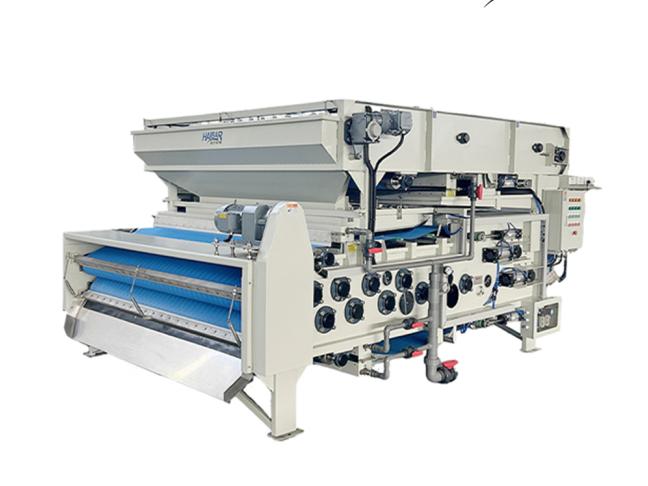
A drum-belt integrated unit thickens sludge on a rotating perforated drum and then dewaters the concentrate on a belt press built into the same frame, so one machine does the job of two. Flocculated feed enters the slowly rotating drum; filtrate drains through the screen while solids build on the drum surface to roughly 4–8% dry solids, then a scraper lays that concentrate onto the belt. The belt then applies low-pressure wedge squeezing followed by high-pressure shear rollers, reaching 18–25% cake solids in a single pass with one drive train and one control panel.
The gain over a separate drum thickener plus press is not just a smaller footprint. A drum belt sludge thickening and dewatering integrated machine removes the buffer hopper, transfer pump and walkway between stages, so there is one less odour and leak point and one operator instead of two. On the question of sludge thickening before dewatering why and how much, the numbers are the real argument: thickening lifts feed from 1–2% to 4–8% dry solids, roughly a 2–5× reduction in liquid volume entering the press, which shrinks the required belt area and cuts polymer dose per ton of dry solids by about 20–40%.
Haibar's HTE drum-belt series is built in its China factory and ships as a skid-mounted unit, so commissioning is a connection-and-run job rather than civil works for two machines. Because the rotating drum sheds a fibrous mat instead of trapping it in a flat deck, drum-belt units stay online on food and pulp sludges that would blind a gravity belt, and the drum speed and polymer injection point are tuned to your specific feed so the unit runs clean rather than needing daily wash-downs.
✅ Bottom line: A drum-belt integrated unit thickens on a rotating drum and dewaters on the same frame, removing a transfer step and cutting polymer per ton of dry solids by roughly 20–40%.
Choose a drum-belt integrated machine when your sludge is fibrous, high-fat or fast-draining and would blind a flat gravity deck, and choose separate stages only when throughput swings far outside one unit's range. The front-end thickening method decides fit, not price. A drum resists blinding on fibrous and sticky sludges, while a gravity-deck (triple-belt) front end suits fine, slow-draining biological sludges better.
| Criterion | Drum thickening (drum-belt) | Gravity deck (triple-belt) |
| Best sludge type | Fibrous, high-FOG, fast-draining | Fine biological, slow-draining |
| Feed DS achieved | 4–8% dry solids | 4–6% dry solids |
| Blinding risk | Low on fibrous load | Higher on fibrous load |
| Relative footprint | ~40% less than two separate stages | ~40% less than two separate stages |
For large municipal or industrial flows, the choice is not drum versus belt but width. Haibar offers the drum-belt as a custom build on an ultra wide belt filter press 3000mm for large capacity sludge, so a single integrated line handles the full plant flow instead of two parallel standard-width units — useful when a greenfield site wants one machine, not a pair. The reason to thicken first, which is the core of sludge thickening before dewatering why and how much, is that every point of feed solids means less water to press, a smaller belt area and lower polymer per dry ton. Keep stages separate only when your flow varies so widely that one duty band cannot cover peak and slack without either starving or overflowing the unit.
✅ Bottom line: Pick the drum-belt front end for fibrous or high-fat sludges and the ultra-wide version for large single-line flows; keep stages separate only when throughput swings outside one unit's range.
Q: Is a drum-belt integrated unit harder to maintain than a separate thickener and press? A: No — a drum belt sludge thickening and dewatering integrated machine has one drive train, one scraper and one belt to service, so planned maintenance is simpler than coordinating two separate machines, though the drum screen needs periodic wash-down on high-fat feeds. As your single supplier for the whole duty, Haibar also stocks the drum screen and belt, so spares are one purchase order instead of two.
Q: Why thicken sludge before dewatering, and how much volume does it actually remove? A: On the question of sludge thickening before dewatering why and how much, thickening lifts feed from 1–2% to 4–8% dry solids, cutting the liquid volume sent to the press by roughly 2–5× and lowering polymer dose per ton of dry solids by about 20–40%. Haibar delivers this as an OEM/ODM skid, so the thickener and press share one control system instead of two separate PLCs.
Q: Can a drum-belt integrated machine handle a large municipal plant's full flow? A: Yes — Haibar builds it as an ODM unit on an ultra wide belt filter press 3000mm for large capacity sludge, so one integrated line carries the full flow where two standard-width presses would otherwise run in parallel.
Send Haibar your sludge type, feed solids and peak flow, and our China factory will return a sized drum-belt proposal — standard or ultra-wide — with a reference plant near you. Shanghai Haibar Mechanical Engineering Co., Ltd. operates an 11,000 m² plant and exports to 30+ countries; contact us for a free pilot assessment and a configured quote.Mobile: +86 13816290005 Tel: +86-21-50192688
Author:
Mr. Shanghai Haibar Mechanical Engineering Co., Ltd.
E-mail:
Phone/WhatsApp:
Email to this supplier
Author:
Mr. Shanghai Haibar Mechanical Engineering Co., Ltd.
E-mail:
Phone/WhatsApp:
Privacy statement: Your privacy is very important to Us. Our company promises not to disclose your personal information to any external company with out your explicit permission.
Fill in more information so that we can get in touch with you faster
Privacy statement: Your privacy is very important to Us. Our company promises not to disclose your personal information to any external company with out your explicit permission.