


Send Message
Privacy statement: Your privacy is very important to Us. Our company promises not to disclose your personal information to any external company with out your explicit permission.

A 3000mm ultra-wide belt press typically processes 40–60 m³/h of 95–97% feed sludge, equal to roughly 1.2–2.0 t of dry solids per hour, and engineers size it from the well-known curve of belt filter press capacity by belt width m3 per hour rather than from guesswork. The exact figure moves with sludge type and polymer conditioning, but the relationship to width is stable enough to plan a plant around.
| Belt width | Feed capacity (m³/h, 96% sludge) | Dry solids (t DS/h) | Approx. footprint (m) |
| 1000 mm | 5–10 | 0.3–0.6 | 6 × 2.5 |
| 1500 mm | 10–18 | 0.5–1.0 | 7 × 3.0 |
| 2000 mm | 18–30 | 0.8–1.4 | 8 × 3.2 |
| 2500 mm | 28–45 | 1.0–1.7 | 9 × 3.5 |
| 3000 mm | 40–60 | 1.2–2.0 | 10 × 3.8 |
| 3500 mm+ | 60–85 | 1.8–2.8 | 11 × 4.0 |
These ranges assume well-conditioned sludge and correct cationic polymer; fibrous or high-fat feeds sit at the lower end. Width, not length, is the lever that sets both capacity and floor space — a principle every manufacturer applies when it issues a belt filter press belt width selection sizing chart like the one Haibar sends to EPCs. The belt filter press capacity by belt width m3 per hour curve is exactly what lets an EPC skip the second unit and still meet peak duty.
Key points when reading the numbers:
✅ Bottom line: A 3000mm belt press delivers 40–60 m³/h (1.2–2.0 t DS/h) on one machine, and belt width — not length — is the variable that sets both capacity and floor space.
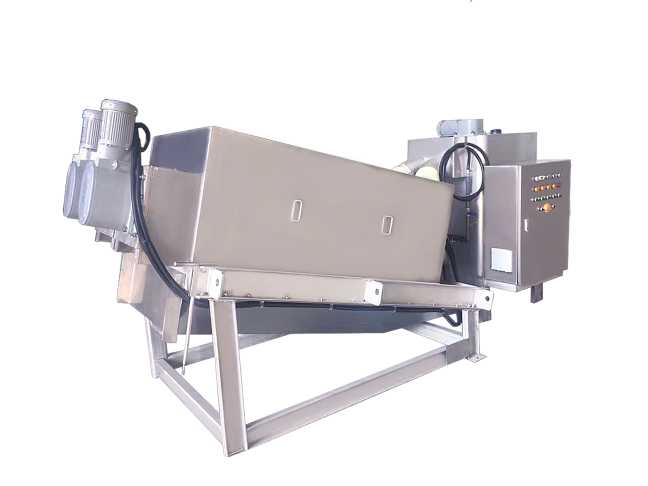
For a large plant with steady high flow, a single ultra-wide line is cheaper to build, run and staff than two parallel standard-width presses, because you pay for one foundation, one belt-wash system, one operator and one spares set instead of two. As a China manufacturer with an 11,000 m² plant, Haibar leads the ≥3000mm segment as an early mover, and that is why EPCs specify ultra wide belt filter press 3000mm for large capacity sludge on greenfield municipal and industrial projects.
The savings break down as:
When a twin-line layout still wins:
Haibar engineers each ultra wide belt filter press 3000mm for large capacity sludge as a custom build, and our belt filter press belt width selection sizing chart folds those constraints — redundancy, flow swing and bay size — into one recommendation instead of a generic datasheet.
✅ Bottom line: Pick one ultra-wide line when flow is steady and you want lower civil, footprint and labor cost; keep twin standard units only when redundancy or extreme flow swings are non-negotiable.
Q: What belt width do I need for a 50,000 m³/day municipal plant? A: At ~1% feed DS and 20 operating hours, you need roughly 1.0–1.5 t DS/h, which a single 2000–2500mm press covers; a 3000mm unit adds headroom for growth. Use the belt filter press capacity by belt width m3 per hour table above and size on DS/h, not m³/h.
Q: Does an ultra-wide belt press need more polymer or energy per ton? A: No — polymer scales with dry solids (2–6 kg/t DS) and is width-independent, while energy per ton of DS actually drops because one wider belt runs at lower specific load than two narrower ones. The wider unit is the more efficient choice per ton treated.
Q: Can Haibar customize a 3000mm press for corrosive industrial sludge? A: Yes. Haibar offers custom SS304/316 contact parts, corrosion-resistant belts and ATEX-rated panels built in-house, and ships a belt filter press belt width selection sizing chart adapted to your specific sludge and cake target.
Send Haibar your feed solids, peak flow and cake target, and our team will return a sized proposal — single ultra-wide 3000mm line or twin standard units — tailored to your duty. Shanghai Haibar Mechanical Engineering Co., Ltd. operates an 11,000 m² plant and exports to 30+ countries; contact our supplier team for a free application assessment and a configured quote.
Author:
Mr. Shanghai Haibar Mechanical Engineering Co., Ltd.
E-mail:
Phone/WhatsApp:
Email to this supplier
Author:
Mr. Shanghai Haibar Mechanical Engineering Co., Ltd.
E-mail:
Phone/WhatsApp:
Privacy statement: Your privacy is very important to Us. Our company promises not to disclose your personal information to any external company with out your explicit permission.
Fill in more information so that we can get in touch with you faster
Privacy statement: Your privacy is very important to Us. Our company promises not to disclose your personal information to any external company with out your explicit permission.